

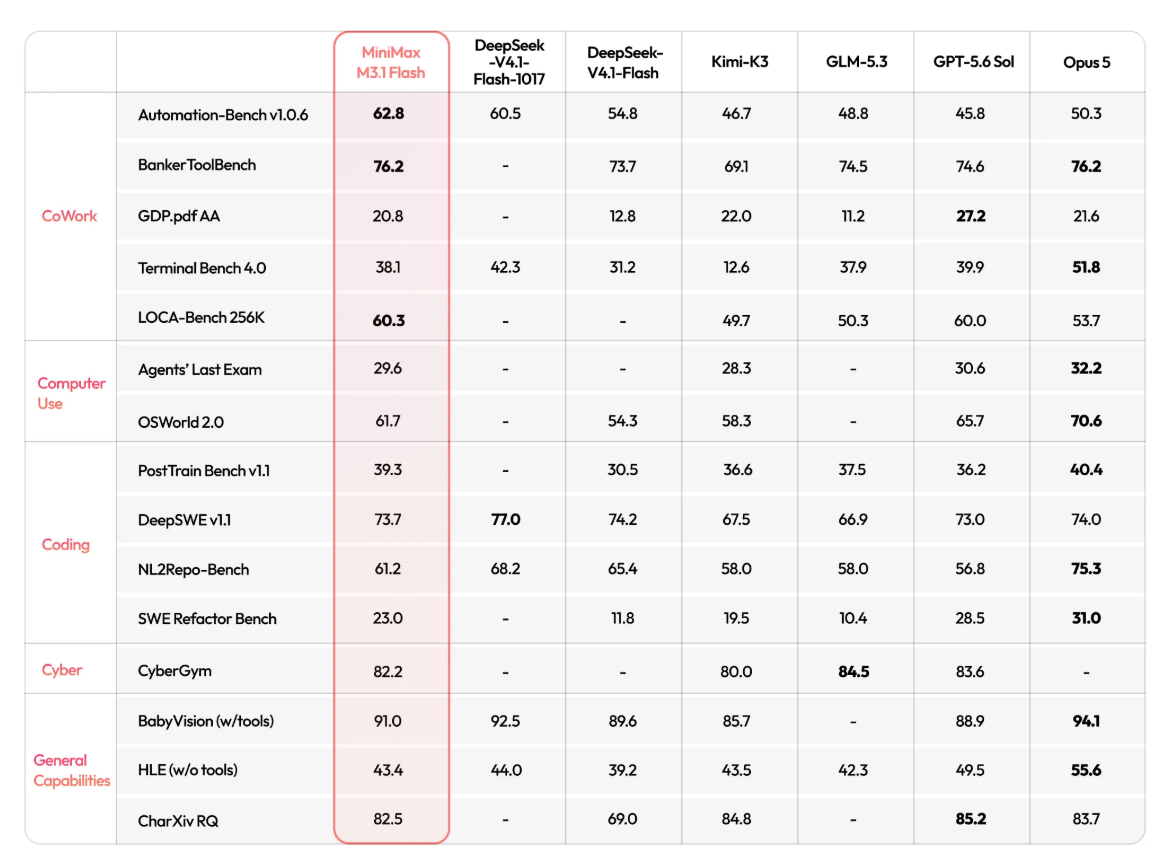
MiniMax rolled out M3.1 Flash on October 19, 2026, with improvements aimed at agentic tasks, coding, computer use, and cybersecurity. In its release announcement, the company reports nearly three times faster online inference and 70% lower overall agent-task usage costs than its predecessor.
The main attraction: lower prices
The announced flat API rates, in U.S. dollars per million tokens, are:
| Token type | Price |
|---|---|
| Input | $0.15 |
| Output | $0.60 |
| Cached input | $0.015 |
The input and output rates match DeepSeek Flash's off-peak uncached-input and output rates in its official pricing table. MiniMax advertises flat pricing throughout the day; DeepSeek has peak and off-peak periods. The cached-input rates differ.
Speed and computer use
MiniMax also reports a first-place result among Chinese models on OSWorld V2 and Agents' Last Exam at launch. These rankings and performance gains are the manufacturer's reported results, rather than a promise for every workload.
For me, the appeal is straightforward: low token prices, fast responses, and the prospect of completing useful tasks at a lower cost. I'd describe that as a competitive price-and-speed proposition, rather than declare one model universally the cheapest.
Adapted from the original Chinese article, published on October 19, 2026. Prices and the scope of the performance claims were checked against the official sources above.
Comments NOTHING