

It has been a while since I last wrote about crypto, so let’s look at the cost of transferring USDT. It is used frequently for payments and moving funds, and the difference in fees between networks can be substantial. Picking a cheaper network can save money, provided the recipient supports it.
These figures are time-sensitive. The dollar amounts below are estimates quoted in my Chinese article of October 22, 2026, not live quotes or independently repeated measurements. Check the wallet’s current estimate before sending. An exchange’s withdrawal charge can also differ from the underlying network fee.
TRC-20 on TRON
TRC-20 has long been a familiar way to send USDT. Years ago, when TRX cost only a few cents, the dollar cost attracted less attention. A higher TRX price makes the same amount of TRX burned for fees more expensive in dollars, although the resource rules and rates matter too.
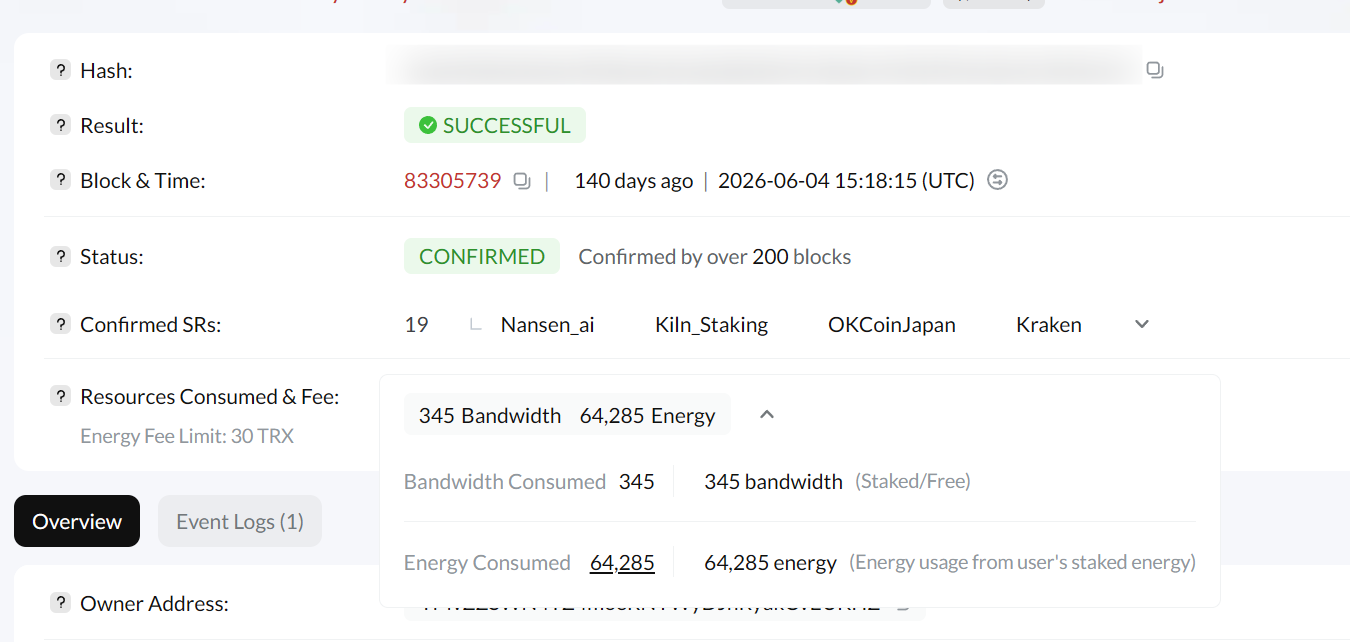
My original comparison quoted roughly 13.4 TRX when sending to an address with no USDT balance and 6.4 TRX when the recipient already held USDT. At the article’s assumed price of $0.30 per TRX, those amounts work out to approximately $4.02 and $1.92. The second figure is roughly half the first, rather than exactly half.
These are scenarios, not fixed tariffs. TRON’s resource documentation explains that transactions consume Bandwidth and contract calls consume Energy; a shortfall can be paid by burning TRX. Its documented Energy rate at this check was 100 sun per Energy, or 0.0001 TRX, and governance can change it. Contract state, available resources and the dynamic Energy model affect the result. An address with no USDT balance is not necessarily a new, unactivated TRON account.
The screenshot is worth reading carefully: it shows 64,285 Energy and 345 Bandwidth, both covered by resources, rather than proof that 6.4 TRX was burned. Its 30 TRX Energy Fee Limit is a budget ceiling, not the fee actually charged. If those 64,285 Energy had instead been paid entirely at 100 sun each, the Energy portion alone would be 6.4285 TRX.
Renting Energy
If you need TRC-20, renting delegated Energy can reduce the amount of TRX burned. The original article mentioned a cost around $1, but this is neither a guaranteed quote nor a network-wide minimum; compare the rental charge and any remaining transaction cost.
One correction to the original: obtaining Energy yourself does not universally require hundreds of thousands of TRX. TRON’s staking documentation describes proportional allocation based on your share of the network’s stake. How much you need depends on the required Energy and current allocation. Running a rental business is a different scale of activity from obtaining resources for personal transfers.
USDT on TON
For people who already use Telegram and a self-custody wallet, TON is another convenient option. The original article quoted under $0.01 and described transfers as almost immediate.
Treat that as an indicative estimate, not a universal fee or arrival-time guarantee. TON’s fee documentation describes several fee components, including computation, storage and message forwarding. Check the full USDT transfer estimate in your wallet: moving USDT involves jetton contracts, rather than simply sending the native TON coin. The receiving service may also wait for confirmations before crediting a deposit.
ERC-20 on Ethereum
Ethereum is another widely supported USDT network, with a more variable fee. My original notes quoted $0.01–$0.10 in quieter periods and occasional rises to $0.30–$0.50.
Those figures do not cap what Ethereum can charge. Ethereum’s official explanation bases the fee on gas used, the base fee and the priority fee, paid in ETH. Waiting may help if demand eases, but there is no rule that a spike must disappear within an hour. Estimate the actual USDT contract transfer, rather than using the cost of a simple ETH transfer.
Other networks with low quoted costs
The original post also listed these approximate figures, all below one US cent:
| Network | Estimate quoted in the original article, USD |
|---|---|
| Solana | ~$0.001 |
| BNB Smart Chain (BSC) | ~$0.002 |
| Polygon | ~$0.001 |
| Aptos | ~$0.0001 |
These are comparison points, not guaranteed all-in charges. For example, Solana’s token documentation explains that creating a recipient’s associated token account requires a refundable storage balance funded by the instruction’s payer. That can add to the funds required beyond the small transaction fee.
Also check which token implementation the recipient accepts. Tether’s integration list identifies official USD₮ deployments on networks including Solana, TON and Aptos. BSC’s familiar Binance-Peg USDT is a bridged representation, explicitly distinguished in BNB Chain’s token documentation. On Polygon, the canonical USDT token was upgraded to USDT0 in August 2025.
The practical choice is a low-cost network that both ends support, with the correct token and deposit instructions. Compare the final charge shown by your wallet or exchange; a cheap network is useful only if the payment can be received on it.
Translated from the original Chinese article, published October 22, 2026. Original estimates are preserved; fee mechanics and token distinctions were checked against official documentation for this translation. No transfer or fee benchmark was performed.
Comments NOTHING