

You have probably come across stories about disciplinary boot camps, so-called internet-addiction schools or institutions that promise to “correct” someone’s behavior. In China, Yuzhang Academy remains a notorious example. The broader “troubled-teen” industry exists in many countries; I see the Chinese version as a particularly serious problem.
This essay looks at the industry from several angles. It includes my own interpretations and judgments, rather than a statistical comparison between countries.
All contributors’ names have been withheld. For readability, I will use “disciplinary schools” as shorthand for the coercive institutions discussed here. Their different labels do not necessarily describe the same legal status or services.
Why do these institutions have a market?
The modern internet-addiction-school business was not always part of family life. But the expectations it exploits are older. In China and parts of East Asia, diligence, academic achievement and obedience carry considerable cultural weight. Many families find it difficult to accept a child who appears to be neglecting school or a conventional career.
In my view, intense social competition feeds that pressure. Parents want their children to succeed rather than fall behind, and may pass those anxieties down to them. Earlier generations might have tried to impose discipline themselves. The internet gave commercial institutions a much wider audience.
Parents see videos of supposedly rebellious young people who return obedient and compliant. Some begin to believe that their own efforts are ineffective and that an institution can deliver the result they want. What happens inside can become secondary to the promise: pay the fee, wait a while, and get back a child who obeys and avoids whatever the parents consider harmful.
I believe that demand, amplified online, helped turn these services into a more developed commercial industry after 2010. The business sells an apparent outcome—obedience—while the person being sent away may have little say in the transaction.
What has changed in recent years?
Some institutions now use labels such as traditional Chinese learning or etiquette education. The Rushi Academy case in Xinchang, Zhejiang, in 2026 is one example. An August 16 official update, reported by Xinhua through People’s Daily Online, said it operated without the required qualifications, used traditional learning and etiquette as the banner for closed training, and engaged in beatings, corporal punishment and restrictions on personal freedom. The findings were also reproduced on the Ministry of Justice’s legal-information platform.
The target population also extends beyond teenagers. A difficult job market and anxiety about the declining value of qualifications can make promises to cure “laziness,” dependence on parents or “giving up” appealing to some families. An adult child staying at home becomes a potential customer—although the parents, rather than that adult, are making the decision.
What disturbs me is that someone in their twenties could be confined against their will simply because an internship has ended, they have not yet found another job, and their family labels the situation as living off their parents.
Conflict can also center on marriage, sexual orientation or a life plan that does not meet parental expectations. Repeated advertisements claiming that an institution can “correct” the person offer a frighteningly simple answer to parents who feel they cannot make their child listen.
For reporting and a legal discussion of why adults are being sent to these institutions, see China Newsweek’s August 28 interview. The existence of a parental request should not be confused with the affected person’s consent.
The internet’s role
This is a technology blog, so I want to spend more time on the distribution system. I believe online platforms bear a major share of responsibility for the industry’s rapid expansion. Without the reach they provide, these institutions would have a much harder time scaling their marketing.
The screenshot below shows a public profile on Douyin, the Chinese short-video platform. It illustrates the public-facing promotional style; the screenshot itself does not establish an individual account’s advertising purchases, targeting settings or unlawful conduct.
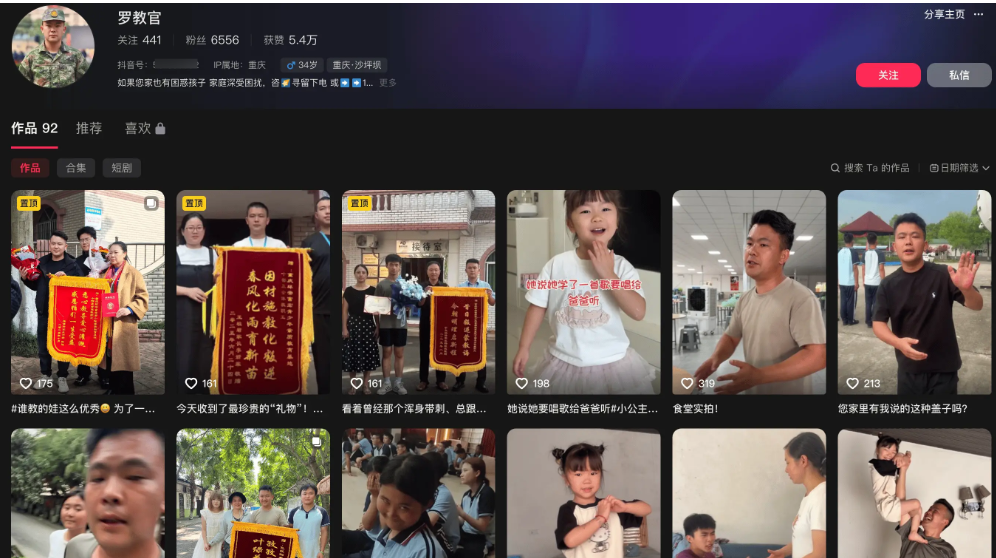
Platforms should scrutinize unlawful promotional content. In my view, this is one of the most practical points at which to intervene in the industry: control the route by which institutions reach new paying families.
My concern is the combination of audience profiling, recommendation systems and paid promotion. Parents who repeatedly watch child-rearing videos can be presented with promises of a child “turning good,” expressing deep repentance or returning home to wash their parents’ feet—a display of filial devotion in this context. Content organized around those promises makes obedience look like something that can be purchased.
As such messages recur, a parent may become convinced that paying an institution will stop a child from “living off the family” or behaving defiantly. The family pays a high price for compliance, while the platform has a commercial incentive to keep the promotional traffic flowing. This is my analysis of the incentive structure, not access to a particular platform’s advertising records.
Platforms are not the only part of the problem. I also see gaps in regulation and enforcement, official inaction, the risk of corruption and wider social expectations as contributing factors. The scope of this essay does not allow every part of that system to be examined in detail.
Excessive parental control and long-standing cultural assumptions can make coercion seem acceptable. Raising a person takes time and attention, yet some parents attribute difficulties entirely to an outside influence, such as games, rather than examine their own relationship with their child. Refusing to follow a conventional path, compete ever harder or immediately find work is then treated as proof that the person has given up. Institutions selling forced “correction” fit that expectation all too well.
Closing thoughts
Journalism, public scrutiny and the work of people who keep pushing these cases into view have helped bring closures. But a closure is not necessarily the end of the business behind it. The Southern Metropolis Daily investigation into Chongqing Huandi, published on Sohu, reports both the shutdown of its original campus and the relocation and continued activity of affiliated operations.
Weaknesses in the legal and enforcement system, the difficulty of preserving evidence and deeply rooted social attitudes remain hard problems. Even so, I hope that persistent scrutiny will keep bringing us closer to something better.
Further reading, in Chinese:
- Official investigation update on Rushi Academy.
- Chongqing Huandi: closure, relocation and the business behind the institutions.
There was originally more material for this essay. We did speak with people who had firsthand experience and received information from them. After discussing and revising the piece with the other contributors, however, we decided not to publish those accounts and to focus on industry analysis. I am grateful to everyone who shared information or helped with the work.
Translated from the original Chinese article, published October 24, 2026. Contributor anonymity and the original image are preserved; official findings, reported events and the author’s analysis are identified separately.
Comments NOTHING