

Hardware-risk notice: GPU Unlock changes low-level firmware behavior to remove issue-rate restrictions on particular compute instructions. Compatibility reports are not a guarantee against hardware damage or system instability. Anyone choosing to use it accepts the risks.
A GitHub project called GPU Unlock has been attracting attention. It uses a vulnerability-based technique to lift a compute-throughput restriction on some NVIDIA consumer GPUs. For local AI workloads, the interesting question is how much of that extra compute turns into useful speed.
At the version checked, the project is a Linux kernel module that runs before the normal NVIDIA driver initializes the card. Its stated target is the issue rate of specific FP16/BF16 operations with FP32 accumulation on GA102, GA103, GA104 and GA106. The claim is a professional-equivalent rate for those instructions, rather than overall equivalence to a data-center GPU.
Reading the BF16 results
The original article described BF16 gains of roughly 50–70% on many RTX 30-series cards. That is a broad summary, not a promised improvement for every card. The project’s user-reported table shows a wider spread: RTX 3090 reports range from +25% to +67%, while RTX 3090 Ti reports show +68% to +80%. It also lists an OEM RTX 3080 Ti 20 GB case where the unlock completes but BF16 remains at half rate.
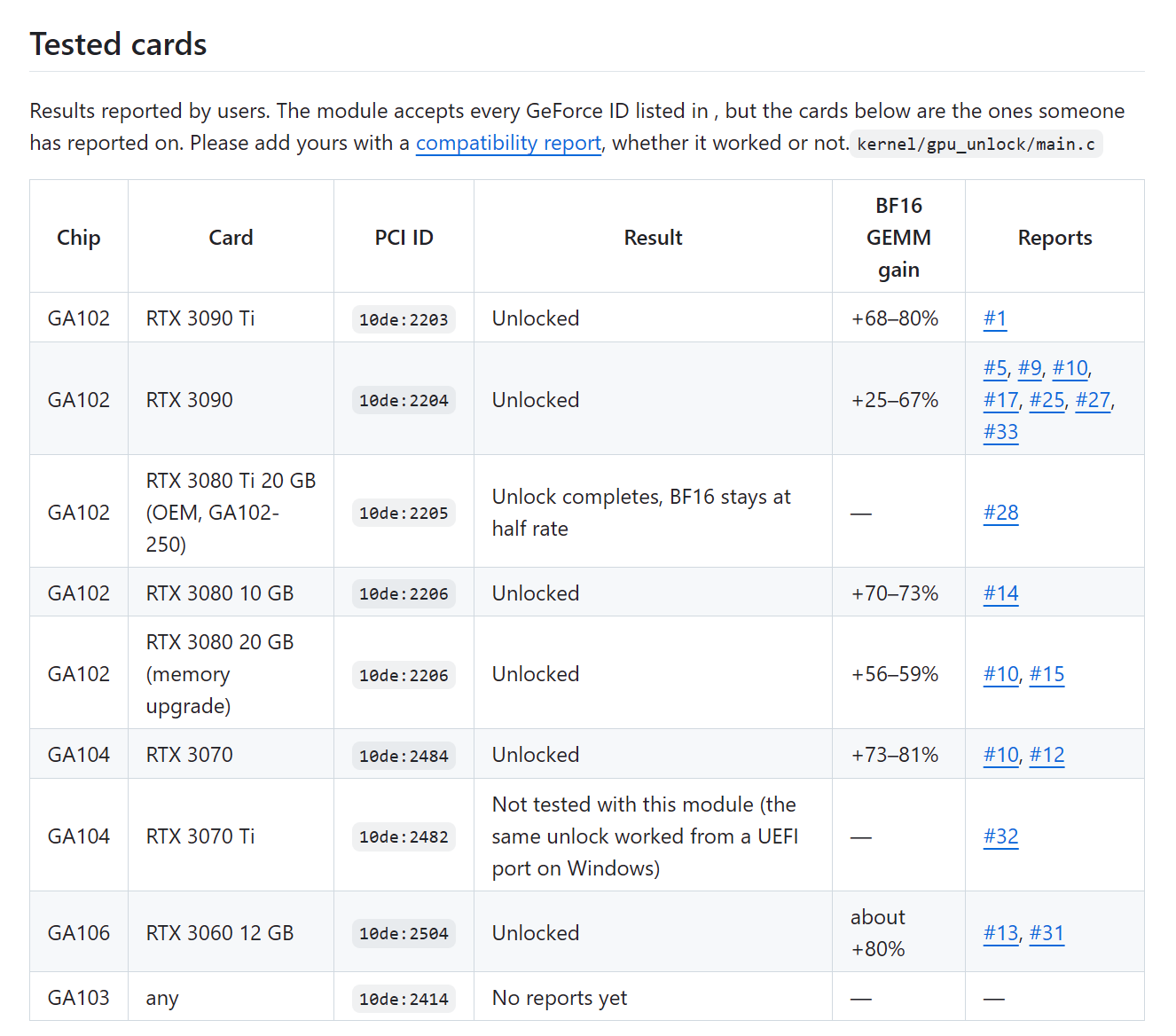
These are dense matrix-multiplication benchmarks, and the reports use different configurations. Card variant, power limit and workload matter. They should not be read as the same percentage improvement in every AI application.
Prompt processing versus text generation
The most useful distinction in the reports is between prefill, which processes the input prompt, and decode, which generates the answer token by token.
For example, report #15 tested two memory-modified RTX 3080 20 GB cards capped at 220 W. Its author reported +56–59% BF16 GEMM and +33–36% LLM prefill in vLLM, but no visible decode benefit beyond run-to-run variation. Another inference engine in the same report gained less on prefill. Quantization and the engine’s compute path also affect whether the unlock helps.
That supports the original article’s main observation: input processing can become faster, while the visible “typing” speed may change very little. A matrix-throughput gain does not translate directly into an equal increase in generated tokens per second.
Who is this relevant to?
My interest here is AI compute. For someone using the card mainly for games, I would not install it just in the hope of more FPS. Compatibility also needs to be checked against the actual card and system: reports include instability, such as a hard lock described in an RTX 3070 report.
Read the project’s current documentation and compatibility reports for the details of a particular setup. The gains discussed here come from project and community reports; this translation adds no fresh hardware testing.
Translated from the original Chinese article, published October 25, 2026. Original chart and hardware-risk notice retained; compatibility and performance claims clarified against project documentation and firsthand reports.
Comments NOTHING